
By Deborah Hopkins, July 15, 2020
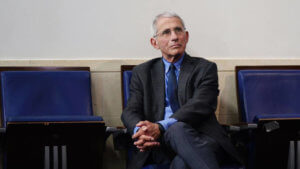 Here’s a hypothetical. Let’s say you have a U.S. President who is in office during a global pandemic, and that president gives an interview to a news outlet and says that the country is in “a good place” with how it is handling said pandemic.
Now let’s say that there’s a high-level career federal employee who works in infectious diseases who makes a statement to a different media outlet that goes something like this: “As a country, when you compare us to other countries, I don’t think you can say we’re doing great. I mean, we’re just not.”
Of course by now you know I’m not speaking in hypotheticals. As it goes with media sensationalism, one of the stories over the past few days surrounds the legality of the President firing Dr. Anthony Fauci, the head of National Institute of Allergy and Infectious Diseases (NIAID). Most FELTG readers are probably aware that Dr. Fauci’s statements on the COVID-19 pandemic have differed somewhat from those of the White House.
The question that is being asked on cable news, in media publications, and perhaps around dinner tables across the country: Can the president have Dr. Fauci fired?
The answer, based only on the evidence available to the public, is probably not. The President himself doesn’t have the authority to fire Dr. Fauci, who is a Title 42 employee and not a political appointee. But were the President to hypothetically order an official at HHS to fire Dr. Fauci, in order for the removal to be legal there would have to be cause — Dr. Fauci would had to have engaged in removable misconduct or poor performance.
Disagreeing with a President most likely does not fall into poor performance or misconduct. In fact, it is a prohibited personnel practice to make an employment-related decision because of a career employee’s political activities. While it may be acceptable for political appointees to be removed for differing opinions than those of their president, the fact that Dr. Fauci does not agree with the President about COVID-19 is NOT a valid reason to fire him.
We don’t know the details of Dr. Fauci’s work at NIH, so we can’t speak specifically to his performance or conduct on the job. However, misconduct, loosely defined, is the violation of a valid workplace rule.
Is a statement made in contradiction with the President misconduct? Probably not. Dr. Fauci doesn’t appear to have violated a workplace rule, as he has authorization to speak to the press about NIAID matters.
What about the list of the times Dr. Fauci “has been wrong on things,” recently compiled by White House. Do these statements rise to the level of poor performance? Without seeing Dr. Fauci’s performance plan, I cannot say for certain.
If Dr. Fauci is fired for any reason, whether it appeared to be legally valid or not, he could appeal his removal to the MSPB and let the Board (if we ever get one, that is) decide whether he engaged in misconduct or poor performance.
In case you’re wondering how Title 42 employees have civil service protections, here’s a brief lesson from Lal v. MSPB, Fed. Cir. No. 2015-3140 (May 11, 2016). Title 42 says that individuals may be “appointed” under Title 42 without regard to the civil service laws. A different statute gives agencies dealing with certain non-Title 42 employees the authority to “appoint[ ]…and remove[ ]… without regard to the provisions of title 5…” Reasoning that Congress saw a significance in the latter situation to include the authority “to remove” and that Congress did not specifically include the authority “to remove” in Title 42, Congress did not intend for Title 42 removal authority to be without regard for civil service protections. So, in sum Title 42 employees are hired under special authority but when it comes to being fired, they get the same protections as most of you in the FELTG Nation. And that includes Dr. Fuaci.
Interesting times, aren’t they? I’ve got some ideas for follow-up discussion and would love to incorporate your thoughts and questions into the content. So, what’s on your mind? [email protected]
 Last week, we published an article about an employee who left his laptop charger in the office at the beginning of the COVID-19 pandemic. The employee claimed he worked 40 hours a week for eight weeks, even though he later admitted he had done no work during that time. I characterized it as an open-and-shut case. It wasn’t seen that way by a number of you in FELTG Nation.
 Thanks for the note, FELTG reader. This one seems so easy to me. The employee is claiming pay for a large amount time when he did not work (approximately 320 hours), which is an egregious act of misconduct.
 This morning, the Supreme Court issued a decision in Altitude Express, Inc. v. Zarda, Bostock v. Clayton County, and R.G. & G.R. Harris Funeral Homes v. EEOC, 590 U.S. ______ (Jun. 15, 2020). The 6-3 decision was written by Justice Gorsuch. He was joined by Chief Justice Roberts, and Justices Ginsburg, Breyer, Sotomayor, and Kagan.
 Back in the day – before COVID-19 – there was a term we used for employees who refused to report to work: AWOL. Or, as our friends in the Navy call it, Unauthorized Absence. The pandemic has created a new scenario though, where a refusal to report to an agency work station might not be considered misconduct, depending on the circumstances.
 These past several weeks have been challenging for all of us. Many of you in the FELTG Nation, and some of us in the FELTG family, have lost loved ones to COVID-19. There’s a lot of uncertainty about what the future holds, as some states begin to re-open while others remain on lockdown. Will things ever return to some semblance of normal? And if so, when?
 One of the most intensely debated topics in the EEO realm for years, has been the proper role of agency defense counsel in agency EEO investigations. Indeed, we’ve
  Today as you read this, over a million federal employees are teleworking because of the COVID-19 emergency. Under OPM regulations, during an emergency an agency may assign any work considered necessary without regard to the employee’s grade or title, including assignments that an employee is given while teleworking.