
Posts

By Dan Gephart, May 27, 2923

Michael Wolf, Director, Collaboration and Alternative Dispute Resolution (CADRO)

In the first of this two-part article, we talked to the Federal Labor Relations Authority’s Michael Wolf, who is director of the Authority’s Collaboration and Alternative Dispute Resolution (CADRO) program about that program’s success. [Editor’s note: Visit here to learn more about CADRO and its services.]

Wolf described CADRO’s style of mediation as “situational” as opposed to “facilitative or evaluative or some other label.” The key, per Wolf, was that the “parties define success.”

We wondered how CADRO’s approach applied to agencies trying to resolve disputes internally. [For more on settling disputes, join FELTG on April 12 for Drafting Enforceable and Legally Sufficient Settlement Agreements.] We caught up to Wolf in between mediations and picked his brain on this important topic.

DG: What do you think is the biggest obstacle to resolving disputes?

MW: It depends. I realize that is not really an answer, but there is no other simple response that is also accurate. Most disputes we see in CADRO erupt from a set of unique causes, characteristics, and obstacles to resolution. From the standpoint of a third party who has no stake in the outcome, we help party representatives identify their obstacles and then help them adopt what they believe to be the most effective way to overcome those obstacles. This approach tends to result in parties that are more invested in making the outcome successful when compared to an outcome imposed by an outside source of authority such as a judge or arbitrator.

DG: What physical environment best creates an atmosphere for successful mediation?

MW: With rare exception, it is best for the physical environment to enable the mediator and participants to be free of unnecessary distractions, engage with an appropriate level of confidentiality, communicate effectively, utilize joint and separate sessions, consult with sources of information and authority when necessary, and be able to fulfill external responsibilities when required.

  • The location should be reasonably available and accessible.
  • Cost should not be a factor in whether a party is adequately represented.
  • The space should not create a perception of favoritism or bias.
  • The need to work outside of “normal” business hours might be a factor.
  • No party should feel unfairly disadvantaged by the physical environment, and it should be compatible with the mediator’s style, methods, and skillset.

I’m sure there are other considerations, but these are what immediately come to mind. I view available options based on five potential methods of engagement:

  • Synchronous and in-person
  • Synchronous and remote
  • Asynchronous and in-person
  • Asynchronous and remote
  • Hybrid – a combination of synchronous and asynchronous, in-person and remote

Each of these methods of engagement give rise to a different set of considerations concerning the physical environment. For example, if one or more participants is expected to engage remotely, the impact of differential technology skills, equipment, support, and access could affect both process and outcome of the mediation.

DG: You’ve been an advocate for the appropriate use of technology in mediation.

MW: I’ve been an advocate for the appropriate use of technology in mediation since at least the late 1990s when I was the FMCS Director of Mediation Technology Services. Today, CADRO mediation and settlement conferences would not be possible without a very heavy reliance on technology and remote engagement, both synchronous and asynchronous. I am not a believer in the use of technology to repair fractured relationships, but I have found it highly effective when used appropriately to mediate labor disputes.

At the same time, I tend to be “old school.” I prefer in-person engagement for disputes that are complex, serious, and consequential. But I also recognize that in-person engagement can enable disputants to misunderstand each other as well as understand each other. At times, in-person engagement can cause a disputant to feel threatened and therefore become defensive, maybe misinterpret what is said and done, and become a barrier to success.

Sometimes mediators can control the physical environment. Other times, we have more control over the factors that impact and result from the physical environment. A skilled mediator should be able to spot the issues on the fly and make necessary adjustments when needed.

DG: Can you name a few steps that someone in a dispute can do to bring two sides together – even if they are on one of the sides?

MW: Let me start with a few of the things I suggest that person should not do. They should:

  • Not pretend to be neutral if they are linked to one of the disputants.
  • Not try to determine or shape outcome.
  • Do their best to not be influenced by judgements or assumptions about the disputants or their issues.
  • Avoid the urge to offer advice (except about process).
  • Not try to save either disputant from themselves.
  • Actively avoid shifting the balance of power between disputants.
  • Not try to shape the disputants’ “truth.”
  • Avoid becoming so frustrated that they feel compelled to adjudicate the matter.
  • Not reveal matters shared with them in confidence.

Above all else, “do no harm.”

Now a few ideas about what they might do to help. First and most importantly, listen actively! Second, help them agree on a problem statement that is in the form of a question to which they both seek the answer. If they can’t agree on the question, it is unlikely they will agree on an answer. Jointly attacking the question can also help them avoid attacking each other. Third, help each person first explore separately and then share jointly why they care so much about the answer to that question. Write down the reasons they care (bullet list, not long paragraphs). Help them compare and contrast what they care about to see what their lists have in common. Generally, they will find it easier to agree on solutions if they share a common list of reasons why they care about the answer to the question.

Fourth, facilitate joint brainstorming of possible answers to the question. Encourage both to offer at least several ideas. The more the better. Get them to think outside the box. Discourage criticism of each other’s ideas. Try to write down every idea, even the ones that seem wacky. Encourage them to build on each other‘s ideas. Then discover the ideas that rise to the top and help them explore whether one or possibly a combination of ideas might be worth trying.

If they seem to agree on one or more ideas as a path forward, help them develop an action plan to implement the ideas. Follow up in several days and then again in several weeks. Help with any operational issues. Refer the matter to someone with expertise and experience if necessary.

[email protected]

By Dan Gephart, March 13, 2023

If you were a private sector employer in certain parts of the country, you might hesitate before offering diversity and inclusion training to your staff. Take, for example, Valencia College in Central Florida, whose president told faculty that an upcoming voluntary diversity training was being postponed until they could ensure that it didn’t violate the state’s new “Stop WOKE Act.”

But that’s Florida. And you, FELTG Nation (or most of you), work for the Federal government. While there are still numerous barriers that need to be eradicated to develop a Federal workforce that reflects the country it serves, there are no barriers to stop you from offering diversity, equity, inclusion, and accessibility (DEIA) training.

In fact, it’s quite the opposite. The current Administration reinforced its commitment to DEIA training recently when the U.S. Office of Personnel Management (OPM) released the recent report Government-wide DEIA: Our Progress and Path Forward to Building a Better Workforce for the American People.

If you’re looking to the report for actual statistics or tangible results showing the impact of President Biden’s 2021 Executive Order on Diversity, Equity, Inclusion, and Accessibility in the Federal Workforce, you’ll have to wait a little longer. This OPM report focuses on the steps the Federal government has taken to align itself with that EO.

“In order to recruit and sustain the best talent, we must ensure every service-minded individual feels welcome and supported in contributing their talents to the Federal workforce,” OPM Director Kiran Ahuja wrote in a press release. “This inaugural report highlights progress made to advance diversity, equity, inclusion, and accessibility in the workplace, and we look forward to continuing the work to break down barriers to serve and help build a Federal government that draws from the strength and diversity of its people.”

The top accomplishment listed is the report was the establishment of the Chief Diversity Officers Executive Council, which includes stakeholders from OPM, EEOC, and OMB along with agency DEIA leaders. Per OPM, the council will:

  • Collaborate on broad strategic and operational matters, projects or programs across the Federal government related to DEIA.
  • Collaborate with member agencies and public and private stakeholders, as appropriate, on DEIA policies and programs in the Federal government and across other employment sectors.
  • Assist with setting clear strategies, benchmarks, and metrics for DEIA standards of excellence and accountability to be employed across the Federal government.
  • Support and advise member agencies on their DEIA strategic plans.
  • Promote the DEIA priorities outlined in EO 14035, and incorporate the following operating principles.
    • Accountability and sustainability
    • Use of data and evidence-based decision-making
    • Continuous improvement and learning
    •  Broad engagement with diverse stakeholders and partners

Other accomplishments listed included the development of two national programs – the Employee Resource Group Summit and the national DEIA Summit 2022, creation of a DEIA Learning Community to share best practices, and the creation of a new DEIA index that was used for the first time in the 2022 FEVS report. The DEIA Index revealed that 69 percent of respondents report positive perceptions of agency practices related to DEIA. We’ll see what that number looks like in the 2023 FEVS report and get an idea of the impact of DEIA training.

The report also details the DEIA Executive Order priorities that you should be thinking about in your organization. This list should give you an idea of where you currently stand in your efforts.

  • Create a framework to address workplace harassment, including sexual harassment. This means promoting training, education, prevention programs, and monitoring to create a culture that does not tolerate workplace harassment.
  • Establish or elevate Chief Diversity Officers or Diversity and Inclusion Officers within agencies.
  • Improve the collection of voluntarily self-reported demographic data about Federal employees to take an evidence-based approach to reducing potential barriers in hiring, promotion, professional development, and retention practices.
  • Remove barriers for low-income and first-generation professionals, including reducing reliance on unpaid internships and expanding paid internship opportunities.
  • Establish new recruitment partnerships to build a more diverse pipeline into public service and facilitate recruitment, including the recruitment of individuals from underserved communities.
  • Advance equity and transparency in professional development opportunities.
  • Serve as a model employer for disabled employees by charging key agencies with coordinating across the Federal government to develop processes to increase accessibility and reduce barriers to employment.
  • Advance equity for LGBTQI+ employees by striving to ensure that the Federal Health Benefits System equitably serves all LGBTQI+ employees and their families.
  • Advance pay equity.
  • Expanding employment opportunities for formerly incarcerated individuals.
  • And, of course, expand the availability of DEIA training so that Federal employees are supported and have the tools to promote respectful and inclusive workplaces.

On that last point, FELTG can help. We are regularly adding DEIA training to our open enrollment offerings. Next up is Nondiscriminatory Hiring in the Federal Workplace: Advancing Diversity, Equity, Inclusion, and Accessibility on April 5 from 1-4:30. If you’d like to bring FELTG’s DEIA training directly to your agency, email me at [email protected]

By Dan Gephart, February 21, 2023

Soon after the Administrative Dispute Resolution Action was amended in 1996, the Federal Labor Relations Authority established the Collaboration and Alternative Dispute Resolution (CADRO) program. CADRO provides mediation for negotiability petitions and arbitration exceptions pending before the Authority and offers training on building healthy workplace resolutions and resolving conflict.

The program developed a reputation (one well-backed by statistics) as a successful resource for resolving complex and sensitive cases. The goal, Director Michael Wolf said is “to improve mission performance, quality of work life, and labor-management engagement.”

This time two years ago, however, there was no CADRO. It was a victim of the previous administration’s strongly held positions on labor relations.

Then-FLRA Chairman Ernie DuBester reestablished the program in late February 2021 and brought Wolf back to the fold. That was followed several weeks later by the return of Merritt Weinstein to his former CADRO position as senior dispute resolution specialist. As Wolf says, he and Weinstein “are CADRO!”

Since CADRO was reestablished, parties requested or agreed to requests for assistance in 51 negotiability cases concerning 554 disputed proposals and disapproved provisions, according to Wolf. The parties resolved all but two of the 470 language disputes in cases that closed. They are currently working on 84 language disputes in nine other negotiability cases.

We caught up with a very busy Wolf to talk about the return of CADRO and its services and get his insight on how best to resolve workplace conflict and avoid grievances. We cover the former in today’s first of a two-part article. You can find Part II here.

DG: What has been the biggest shift or change you’ve seen in cases that come your way compared to the previous iteration of CADRO?

MW: The biggest change has been the volume of ULP [Unfair Labor Practice] cases in which we are conducting settlement conferences. To help expedite clearing a backlog of more than 450 ULP charges that the FLRA Office of General Counsel deemed meritorious and queued for issuing a complaint, the FLRA Chief Judge has ordered the parties in virtually every case to participate in a settlement conference before the case can be heard by an ALJ. [Editor’s note: Due to the absence of a GC at the Authority during the previous administration, the FLRA built up a backlog of ULP cases.]

Parties appear to have done a great job settling backlogged cases before they entered the Settlement Judge Program. By this summer, CADRO staff expect to conduct settlement conferences in the last of almost 300 backlogged ULP complaints that have entered the Settlement Judge Program, plus dozens more pre-complaint ULP cases.

DG: How long did it take to get the program up-and-running again at full speed?

MW: Merritt and I found ourselves running at top speed almost immediately. During our first 12 weeks back in CADRO, we were actively involved in 15 negotiability cases containing 147 language disputes. Parties successfully resolved 145 of those language disputes during our mediation process, as other unions and agencies submitted additional requests for CADRO assistance in negotiability cases.

We started sprinting at more than full speed when ULP complaints started to issue in mid-2021. Now that we are mediating arbitration exceptions again, we are not letting our foot off the gas. We try to resolve negotiability cases in eight to ten weeks. We try to resolve ULP complaints in about twelve weeks. Our settlement rate for negotiability cases since CADRO was restored is just over 90 percent. Our settlement rate for ULPs is about 85 percent.

DG: For those out there who have never used CADRO, why should they choose it?

MW: Workplace conflict is inevitable. If we manage conflict poorly, it is more likely to be costly and destructive. At CADRO, we utilize specialized knowledge, skills, and decades of experience helping representatives of management and unions prevent conflict from becoming destructive and, when it cannot be prevented, to manage and resolve it constructively. This can help improve mission performance, quality of work life, and labor-management engagement. Those are the three legs of a sustainable, labor-management relationship that is value-added rather than a cost of doing business.

DG: Describe CADRO’s approach to mediation?

MW: Our style of mediation is “situational” rather than facilitative or evaluative or some other label. Parties define success, which might not include settling the litigation pending before FLRA. We rely on problem-solving skills, listening skills, negotiation skills, organizational familiarity, and substantive familiarity to offer parties the best opportunity to satisfy their legitimate interests. We offer parties an opportunity to go beyond the legal questions that gave rise to their case, if both want to, and explore ways to resolve the underlying problems that triggered litigation in the first place. We strive to earn parties’ respect by being neutral, ethical, and patient yet persistent. We use an interest-based process that is collaborative, confidential, low-risk, relatively informal, and normally requires only one ground rule: treat each other with mutual respect.

Another important reason people choose to use CADRO is results. We have a track record of helping parties achieve what they identify as most important, and almost always far quicker than waiting for a litigated outcome.

[Editor’s note: Visit here to learn more about CADRO and its services. For more on settling disputes, join FELTG on April 12 for Drafting Enforceable and Legally Sufficient Settlement Agreements.] [email protected]

By Dan Gephart, February 14, 2023

It was a reasonable accommodation success.

Until it wasn’t.

The accommodation process is a fluid one. You can’t provide an accommodation and then forget about it. This is particularly important now, as many employees with reasonable accommodations make their way back to the physical workplace.

Kristopher M. v. Department of Transportation, App. No. 2019001911 (EEOC 2020) provides a perfect lesson on the importance of continuous communication with employees AFTER they receive accommodations, something that we at FELTG have coined the “Check-in.”

[Editor’s note: For more on this topic, register for Revisiting Existing Reasonable Accommodations, a 60-minute webinar on April 13.]

Upon his hiring in 2005, an IRS agent requested and received a BAT keyboard as a reasonable accommodation. The agent had paralysis in his left hand and the keyboard allowed him to enter data with his right hand.

So far, so good, right?

Fast-forward seven years. The employee’s typing workload increased, causing serious strain, fatigue, and a tingly pain in his right hand. The BAT keyboard was no longer an effective accommodation. The agent requested Dragon software in 2012, and the agency approved it. The software was installed on the employee’s computer, and he was provided training.

So far, so good, right?

Unfortunately, the Dragon software did not work well with the agent’s computer. His computer screen would freeze. Applications would just shut down. He was unable to simultaneously use the Dragon software with the other software programs required for his job (Word, Excel, etc.).

It is here, FELTG Nation, where the process broke down.

The agent struggled with the software and let the agency know. Per the EEOC decision, it appears that there was a back-and-forth between the reasonable accommodation staff and IT about who had the responsibility to address the employee’s computer issues. Meanwhile, the employee went back to using the BAT keyboard. He developed carpal tunnel syndrome in his right hand and pain in his right arm and neck.

Even though it had twice listened to the employee and gave the employee his requested accommodation, the agency still failed to provide the employee with an effective accommodation, per the EEOC AJ.

On appeal, the commission determined the agency’s efforts to deal with the Dragon software/computer issues were either unduly delayed or only partially implemented. The Dragon software was not an effective accommodation, the EEOC ruled. It ordered the agency to engage in a rigorous interactive process with the employee for a 60-day period to come up with effective accommodations.

Wouldn’t you rather just do the FELTG Check-in with employee, see how the accommodation is working and make the adjustments, when necessary, rather than be ordered by the EEOC to conduct a specified period of the interactive process?

The FELTG Check-in is free and ensures that your employee has all the tools he/she/they need to do the job’s essential functions and help the agency meet its mission. Skipping the FELTG Check-in could be damaging to productivity, morale, and the agency’s bottom line. Beyond the required interactive process, the agency in the Kristopher case was required to:

  • Pay the agent $75,000 in compensatory damages within 60 days.
  • Pay the agent $68,761.69 in attorney’s fees and costs ordered by the AJ within 60 days.
  • Provide the supervisors and coordinators involved to take at least eight hours of reasonable accommodation training.

Remember: Your agency’s obligation to provide an effective accommodation does not end when you provide an accommodation. You must ensure the accommodation is actually effective. [email protected]

By Dan Gephart, January 17, 2023

Meet the new year. Same as the old year.

After scouring numerous reports, studies, blogs, and magazine articles by “workplace experts,” the top three challenges and trends that will most likely impact Federal workplaces this new year look very similar to the challenges and trends we discussed this time last year:

  • Telework, remote work, and other flexibilities
  • Employees’ mental well-being
  • DEIA initiatives

Telework, remote work, and other flexibilities. For years, good government groups would put out report after report touting the benefits of telework for the Federal workplace. And year after year, those reports would go ignored, only to be brought up during the occasional Snowmageddon.

But after two-plus years of pandemic-enforced remote work, the argument that telework won’t work doesn’t hold water. It did work. In fact, it worked quite well in many cases.

Meanwhile, many employees are not so eager to return daily to an official physical location. Why should they? Remote work allows for better work-life balance for employees, and the lack of a commute saves money and time.

The benefits of telework, remote work, and other flexibilities can no longer go ignored, especially in an employee market. Nearly 60 percent of the employed respondents in McKinsey’s American Opportunity Survey  say they work at least part of the time remotely. Ninety-two percent of millennials say flexible working is a top priority when job hunting and 70 percent of all employees say flexible work options make a job more attractive, according to a survey by software company Sage. Meanwhile, 87 percent of employers offered at least some flexible  work options. If you’re not one of those employers, good luck keeping and finding talent.

For the FELTG Nation, this trend presents two specific challenges, both of which we’ll be focusing on in upcoming training:

  1. Addressing an increase in the number of reasonable accommodation requests for telework. Join us next month (Feb. 16, to be exact) for Reasonable Accommodation: Meeting Post-pandemic Challenges in Your Agency.
  2. Ensuring accountability of employees who work remotely. UnCivil Servant, held next on Feb. 8-9, offers step-by-step guidance on addressing accountability for performance and conduct, regardless of where the employee is working. (Also, a recording of the recent webinar Handling Teleworker Performance and Conduct Challenges is available on the FELTG website.)

Employees’ mental well-being. The Indeed and Glassdoor Hiring and Workplace Trends 2023 Report noted that: “Employees are demanding greater wellbeing in their experience at work, including increased levels of happiness, satisfaction, purpose, and manageable stress.”

Forbes Magazine also listed “Mental well-being gains importance” among its 2023 workplace trends. It’s easy to see why. The magazine shared a survey by employee well-being website Gympass that found nearly half of all employees reported a decline in mental well-being over the last year.

Shana Palmieri, LCSW shared other alarming statistics in last month’s FELTG Newsletter:

“Prevalence rates of anxiety and depression rose 50 percent and 44 percent, respectively, according to an article in Translational Behavioral Medicine. This rate was six times higher than in the pre-pandemic year of 2019. The most significant impact was found for those aged 18 to 29, with rates of anxiety and depression jumping to 65 percent and 61 percent, respectively.”

Shana will present Grappling With Employee Stress in the Workplace: Improve Performance and Morale at Your Agency on March 23.

DEIA initiatives. If you’re looking at DEIA initiatives as solely a top-down initiative from the current Administration, you’re looking at it wrong. The younger workforce is demanding employers’ focus on DEIA. Look at these statistics from the Indeed-Glassdoor report that reflect the views of workers aged 18-34:

  • 72 percent would consider turning down a job offer or leaving an employer if they did not think that their manager (or potential manager) supported DEI initiatives.
  • 67 percent would consider turning down a job offer or leaving a job if there was a gender imbalance in organizational leadership.
  • 65 percent would consider turning down a job offer or leaving a job if there was a lack of race/ethnicity diversity in organizational leadership.

But it’s not just young people: 74 percent of all surveyed US workers say that corporate investment in diversity, equity, and inclusion is “very important” or “somewhat important” to them when considering a new job.

As last year progressed, we at FELTG noticed a growing interest in Barrier Analysis training. That’s a good sign that agencies are focusing on the root of diversity imbalance and not just on filling out an MD-715 form.

In our DEIA training, we’ve discussed the importance of psychological safety when it comes to inclusion. Psychological safety, as defined by J. Bruce Stewart, is the “ability of a person to feel safe in speaking up at work or in the community, especially if that person has a different perspective or viewpoint.” Psychological safety is not just a key inclusion factor, it is being used in many studies as a measure of employee well-being in the workplace.

In fact, there is a lot of overlap in the ways to address these three trends. Paying attention to all three will make your agency a happier and more productive workplace in 2023. And FELTG will be there to help you achieve those goals. [email protected]

By Dan Gephart, December 13, 2022

Happy Holidays FELTG Nation! Welcome to the fourth annual year-end News Flash, where we unveil the most popular FELTG newsletter stories (based on the number of reads and forwards) of the previous 12 months.


The 2021 Year in Review was strewn with stories on vaccine mandates and other pandemic challenges. Even with my subpar math skills, I can figure out how many stories on those topics made it into this year’s top story list.

Zero.

That’s right. Pandemic-related issues haven’t disappeared. And our COVID-19 stories and guidance continued to receive a lot of eyeballs in recent months. However, pandemic-related stories were not among the top two most read and forwarded articles in any specific month this year. What were people reading then?

Considering this is the first time we’ve compiled the top story roundup with a full MSPB in place, it’s not surprising that a majority of the most-read stories involved new MSPB decisions. Since the MPSB returned to deciding cases, FELTG has been at the forefront of reading and interpreting them for Federal practitioners.

We continue to hold up our end of this bargain. Join FELTG President Deborah Hopkins on Feb. 14 for latest session of Back On Board: Keeping Up With the New MSPB, our quarterly two-hour review of the newest and most critical Board decisions.

Beyond new MSPB guidance, people read articles on harassment, union meetings, DEIA initiatives, and much more. Let’s take a look back month by month.

January

If you’ve ever been in a class taught by FELTG Instructor Ann Boehm, you’ve heard her refer to the Office of Folklore, or as it’s better known – OOF! OK, so it’s not a real office. Ann uses OOF to explain how bad information gets circulated as the truth. It happens a lot more than you’d think (or hope).

Here’s a specific example. We hear from many professionals who use the following equation to distinguish between performance and conduct cases: Can’t = performance and won’t = conduct. Ann tackles this federal employment law version of fake news in our most-read article of January. As Ann conveyed so clearly: Instead of can’t versus won’t, rely on the performance plan’s critical elements when deciding between a performance or misconduct action.

Speaking of performance, if your agency’s performance year coincides with the calendar year, you are likely working on performance narratives now. If that’s the case, FELTG Senior Instructor Barbara Haga has a clear message for you: It’s Time to Do Better. That message clearly resonated with readers.

February

According to a very unscientific poll (that means it’s my guess), February generated more shrieks of “WTF” in FELTG Nation than any other month.

People read about the ambulance company that failed to respond properly to a harassment allegation. Quick recap: An EMT was fired fewer than 24 hours after she received an unwelcome picture of a sexual nature from a coworker. Although it’s an older case that doesn’t involve a Federal agency, the story offers a lesson to Feds about the importance of investigations.

Meanwhile, Barbara’s tale of a staffing specialist hired AFTER recently facing a suspension AND being the subject of a sexual harassment investigation at his previous agency was the second most-read article.

March

So, you wonder: How did that staffing specialist get hired? It turns out, he lied on his SF-85Ps. You think that’s ridiculous? In Barbara’s March follow-up column, we find out why he lied.

Meanwhile, Ann Boehm provided some Good News for agencies when she answered thequestion: Does the union get to attend every meeting between me and an individual bargaining unit employee? Ann answers: “It depends, probably not as often as bargaining unit employees think.” She laid out specific guidance on when the union does have that right, per Weingarten meetings. No wonder it was most read story of the month.

April

It’s difficult to capture in writing the excitement at FELTG Headquarters in April. It wasn’t the
beginning of the baseball season or the arrival of spring. We had MSPB cases once again!

In this most-read article of April, Deb shared three lessons learned from the new MSPB’s decisions. Ann’s Good News: The Union Doesn’t Get to Attend Every Meeting, this time with the focus on formal meetings, was a close second.

May
If there is any theme running through this year’s top stories so far, it’s that 1) Barbara Haga writes a lot of stories about poor-performing or misbehaving officials who should really know better; and 2) you all love to read about them. You met the lying staff specialist in February and March and, in May, Barbara introduced you to a Chief Operating Officer who was removed for conduct unbecoming – the most-read story of May. [Hornsby v. FHFA is an important decision. Read Deb’s takeaways.]

On the flip side, we don’t hear much about supervisors being harassed by employees. Have you ever thought about filing an EEO complaint against an employee? Can you? In May’s second most popular story, Deb confirms that supervisors can file an EEO complaint. But it’s much quicker and more effective to handle the harassment as a conduct issue. In the particular case discussed in Deb’s story, a supervisor was harassed because of his sexual orientation.

June

Longtime residents of FELTG Nation are well aware of the trio of 2010 Board decisions on comparator employees that we dubbed the “Terrible Trilogy.” We preached again and again that these misguided decisions put too large of a burden on agencies to be consistent with agency-wide discipline. Twelve years later, the MSPB came around to the FELTG way with a decision that offered clear, specific, and reasoned guidance on who counts as a comparator employee in an adverse action under Douglas factor 6. Deb’s story on this important new case was our most-read article in June.

Not all cases can be groundbreaking, precedential decisions. But even relatively unremarkable, non-precedential MSPB decisions can teach or reaffirm best practices everyone should know, as FELTG Past President Bill Wiley discussed.

July

When it comes to whistleblowing cases, the MSPB has tended to interpret “covered personnel action” quite broadly. Not so anymore. Ann Boehm shares the Good News about a recent Board decision, reminding us that the employee has the burden to show a “significant change” in duties, responsibilities, or working conditions. It was the most-read story of July.

Meanwhile, Deb addressed the workplace struggle (for some) with pronouns – an important piece of the gender identity equation. Refusal to use an employee’s preferred pronoun, or name, has been problematic for agencies in recent years, not just from a liability perspective, but because of the impact of the harassment on the complainants.

August

Longtime Board observer Bill Wiley has been very impressed with the work of the new MSPB. Granted, like most practitioners, Bill was glad to see anything coming out of MSPB HQ after a five-year drought of decisions. Still, the occasionally cantankerous FELTG founder called the Board’s legal analyses “well-based and consistent with common sense, upholding much and modifying where necessary.”

But …

(You knew a but was coming.)

Bill found issue with one MSPB decision involving an employee initially removed for conduct unbecoming. The case gets much more complicated than that, and it involves a discussion of who gets to determine whether an employee is probationary. The most-read story of August definitely deserves another look.

As most of you know, FELTG not only offers open enrollment training, but we can come to your agency (onsite or virtually) to provide training for your team.

[I’m interrupting myself here to let you know: If you’re interested in this kind of training, contact me at [email protected].]

We received a lot of inquiries for agency-specific training last year on the topic of harassment. But we received an interesting request along with many of those inquiries: Can you please also cover what is not harassment, especially when it comes to supervisory actions?

We’re talking setting deadlines. Creating a telework schedule. Enforcing a dress code. Providing performance feedback. As long as these supervisory actions are taken reasonably, they are not harassment. Can a supervisor cross the line from effectively supervising employees to creating a hostile work environment? Yes, it’s possible. Deb provides the clear distinction for what is and isn’t harassment.

September

Sleeping on the job. Conducting personal business while at work. Work remotely even though you’re required the employee to return to the physical workplace. Let me spell it out for you: A-W-O-L. Yes, it is possible to be Absent Without Leave even if you’re at work. And that includes working at a remote site.

Many of you worried when employees told you that they did not want to return to the physical workplace. It was a big enough concern to make this our top-read story of September.

Also in September, Deb shared an ugly case of harassment based on disability. A high-level supervisor mimicked an employee with a visible disability in a meeting with all of his coworkers. Here’s the takeaway for all agencies: Take prompt, corrective, and effective action against harassment.

October

During a training session, an attendee told Ann that her agency attorneys suggest “we always advise employees of their Weingarten right.” Ann was aghast. So, she wrote a Good News column explaining to readers the statutory language makes it crystal clear that the agency representative does not have any such obligation.

FELTG has been around for more than 20 years now. Since the beginning, we’ve told agency reps and supervisors that if you’re charging misconduct that begins with an F word (no, not F%@! for F%@! sake – we’re talking falsification, fraud, false ____, etc.), you better make sure you have evidence that the employee intentionally provided false information. There are numerous case law examples out there, and Deb shared a new case example from the MSPB in her popular October article.

November

Agencies have a right to expect a higher standard of conduct from officials who occupy positions of trust and responsibility. You know, supervisors, agency leaders, law enforcement officers, Senior Executive Service members. They should all know better, right? Well, you can add another category to that list — HR professionals.

In our top story of November, Deb wrote about an MSPB precedential decision involving a GS-9 supervisory specialist, who engaged in conduct, such as:

  • Calling subordinates “sexy” and “beautiful.”
  • Commenting on what a subordinate was wearing, including “you look nice,” and you “should wear dresses more often because [she] has nice legs.”
  • Leering.
  • Staring at a subordinate’s rear end.
  • Continuing to make comments even after the subordinates told him he had crossed a line.

An accident occurs at work, and the employee seeks workers’ compensation. But you (and others) think the employee was high or drunk when the accident occurred. An easy call, right – order a drug test, then decline the workers’ comp? Not so fast, guest columnist Frank Ferreri warns in our second most-read story of the month. Frank’s article is filled with case examples that provide a lot of insight.

December

When an agency loses a case, it’s more likely to be because of due process errors – and not the evidence. No wonder readers flocked to Deb’s story this month that offered due process lessons from three recent MSPB decisions.

FELTG Senior Instructor Barbara Haga has taught a lot of training sessions on the topic of reference checks, with a focus on making sure those doing the hiring have all the information they need from the applicants and previous employers. So, you can probably guess Barbara’s opinion on OPM’s newly released guidelines allowing agencies to use clean record agreements again. As Barbara said, you can use clean record agreements. But should you?

I’m not much of a prognosticator, but I’m sure MSPB decisions will make up a nice chunk of 2023’s Year in Review. But there will also be other issues that we can’t foresee. Regardless of the issue, we can guarantee that FELTG will be there to help you steer through any employment law challenges with the most up-to-date and engaging guidance – whether via web stories or in training classrooms.

Happy holidays and best wishes for a great 2023. [email protected]

By Dan Gephart, December 6, 2022

As she nears completion of the first six months of her tenure as a Federal Labor Relations Authority member, Susan Tsui Grundmann is very optimistic about the agency. We caught up with Member Grundmann a couple of times over the past several weeks, and she was eager to discuss the issues that have her enthused about the FLRA’s direction.

  1. Formalization of a relationship with FLRA’s internal union.
  2. Re-establishment of the Collaboration and Alternative Dispute Resolution Office (CADRO).
  3. FLRA’s return to the top 10 of the Best Small Agencies to Work list.

The FLRA union

“We meet on a regular basis,” Grundmann said about the agency and its union. “We have to lead by example. The people on the ground have great ideas. Look to the people who do the work as well as those who do it through other people. Give everyone a voice at the table.”

The agency and the union are working closely on returning employees to the physical workplace. They agreed to a return after 14 straight days with a reduction in transmission rates recorded in all regions followed by a 30-day notice provision. During our conversation with FLRA Chairman Ernest DuBester back in April, the hope was for a mid-May return. Months later, the virus still has different plans.

CADRO
Speaking of Chair DuBester, one of his first acts was to reinstate CADRO, which once again is led by Michael Wolf.

“CADRO is back,” Grundmann said. “They have an astonishing resolution rate of nearly 100 percent in negotiability appeals. Now when you file a ULP, you have an opportunity to go to CADRO.”

During the 18-month period since CADRO was restored in 2021, it has fully resolved 35 negotiability petitions containing 414 language disputes, according to Wolf. A 36th case was partially resolved.

As of Oct. 31, CADRO has handled 127 ULP cases. So far, per Wolf, only three cases required a hearing and 11 were resolved on motions for summary judgment. The rest of the 113 cases were fully resolved through the settlement conference process.  That’s a success rate just under 90 percent.

A best place to work

In 2020, the agency ranked 23rd among small-size agencies with a score of 64.6. The scores are calculated based on three questions in the Federal Employee Viewpoint Survey (FEVS):

  • I recommend my organization as a good place to work.
  • Considering everything, how satisfied are you with your job?
  • Considering everything, how satisfied are you with your organization?

In 2021, that score jumped to 78.4, vaulting the agency into 7th place in the list just behind the Farm Credit Administration. Why the sudden jump?

“Our employees have always had a strong sense of purpose towards the agency mission, which is to protect rights and facilitate stable relationships among Federal agencies, labor organizations, and employees while advancing an effective and efficient government through the administration of the Federal Service Labor-Management Relations Statute,” Grundmann said.  “Because we didn’t have a General Counsel for several years, ULP complaints couldn’t be issued and regional employees couldn’t do a significant part of their jobs.  I think the President’s appointment of Charlotte Dye as Acting General Counsel, which enabled this important work to start up again, likely had a positive effect on employees’ morale.

“Additionally, as an agency, we recommitted to our mission by redeveloping a robust training and education program and restoring CADRO.  We also demonstrated to our employees that we will engage with them by once again recognizing their exclusive representative and re-establishing our own labor-management forum.”

Grundmann thinks it’s important not just for FLRA employees, but for all Federal employees, that FLRA is viewed as a good place to work.

“If we are in the business of addressing issues between agencies, its unions, and its employees, we should be viewed by our own employees as embodying the core principles that the employee viewpoint survey measures: employee engagement and satisfaction,” she said.

[email protected]

By Dan Gephart, December 6, 2022

Five years ago, it was young men carrying torches and shouting “Jews will not replace us” on the eve of the violent Unite the Right rally in Charlottesville. Four years ago, it was a 46-year-old man killing 11 and wounding six at the Tree of Life synagogue in Pittsburgh. More recently, celebrities, athletes, and news networks have thrust antisemitic tropes and conspiracy theories into the public consciousness.

Antisemitism has been increasing steadily since 2016. Last year, the Anti-Defamation League recorded the most antisemitic incidents since it started tracking the data 40 years ago. It’s widely expected that 2022 numbers will be much higher.

It should come as no surprise that these hateful stereotypes have found their way into the workplace. Yet, the results of a recent survey by the company Resume Builder were still outright shocking and should make the message clear to anyone involved in their agency’s DIEA efforts: You must address “antisemitism and cultural competency on Jews and Jewish issues” as part of your workplace DEIA strategy.

Last month, Resume Builder surveyed 1,131 hiring managers and recruiters in the U.S. The results were alarming, to say the least.

  • 26 percent of hiring managers say they are less likely to move forward with Jewish applicants. The top reason is the belief that Jews have too much power and control.
  • 26 percent make assumptions about whether a candidate is Jewish based on their appearance.
  • 23 percent say they want fewer Jews in their industry.
  • 17 percent say leadership has told them not to hire Jews.
  • 33 percent say antisemitism is common in their workplace, and 29 percent say antisemitism is acceptable in their company.
  • 9 percent say they have a less favorable view of Jews than they did five years ago.

Last year, the EEOC commissioners unanimously approved a resolution condemning violence, harassment, and acts of bias against Jewish individuals.

Earlier this year, EEOC Commissioners Keith Sonderling and Andrea Lucas spoke during a webinar addressing the rise of antisemitism in work and education settings.

“Too often, incidents of antisemitism in the workplace go ignored, but we cannot dismiss them,” Lucas said. “These insidious acts can contribute to a culture of hate that may give rise to physical violence later.”

The ADL’s Stand Up Against Antisemitism noted the many ways that bias and discrimination against Jews can manifest in the workplace:

  • Microaggressions around Jewish culture or the way people look, such as one employee telling their Jewish coworker “Oh, you don’t look Jewish.”
  • Tensions and hostility around geopolitical issues. For example, Jewish coworkers being held accountable, demonized, and harassed during conflagrations in the Middle East, or Jewish employees being seen as indistinguishable from Israel.
  • Pervasive stereotypes about Jews that go unchecked, such as “Jews have too much power.”
  • Denial of advancement opportunities
  • Inequitable out-of-office policies and holiday observances
  • Philosemitic remarks intended to be complimentary. For example, “give this task to David since Jews are good negotiators.”

Agency leaders need to set an example, unlike these leaders:

  • The Philadelphia City Commerce Director who called the story of Schindler’s List mere moneymaking “propaganda.”
  • The Salt Lake City CEO who sent an email to other Utah-based tech leaders claiming the COVID-19 vaccine is part of a plot by “the Jews” to exterminate people.
  • The Google Global Diversity lead, who resigned after a blog post he wrote surfaced: “If I were a Jew I would be concerned about my insatiable appetite for war and killing in defense of myself.”

And then there was the supervisor in Lashawna C. v. Dep’t of Labor, EEOC Appeal No. 0720160020 (Feb. 10, 2017), who during an e-mail conversation about work hours and schedules, told a Jewish employee he (speaking about himself) had been working like “a Hebrew slave.” This supervisor’s actions proved costly to the agency, which was found liable for the harassment due to a lack of evidence that it exercised reasonable care to prevent and correct the harassment.

It’s not just leaders, though. All employees play a role in preventing and addressing these behaviors, Commissioner Sonderling said in the aforementioned webinar.

If you lead agency DEIA efforts take note: A workplace is not inclusive if any type of bias goes unchecked. As the ADL wrote: “This results in psychological harm, unhealthy interpersonal interactions, inequitable workplace policies and procedures, diminished employee productivity, and lack of accountability across the organization.” [email protected]

[Editor’s note: Keep up to date with DEIA articles and training opportunities via FELTG’s DEIA Guidance and Resources.]

By Dan Gephart, November 15, 2022

I watched my no longer undefeated Philadelphia Eagles take on the Washington Commanders on Monday Night Football. I am usually a wreck watching my Birds, and the last few weeks have been more anxiety-filled than ever. Despite the loss, the game was less stressful. The reason? I wasn’t forced to watch dozens of political ads during the game.
Regardless of where you are on the political spectrum or how you feel about last week’s results, I think we can all agree on saying good riddance to these dark, poorly produced, truth-averse, fear-mongering commercials. This past election season took awfulness and ugliness to a new level.

As losing candidates and parties continue their post-mortems this week, I’d like to conduct one, too. But I don’t want to discuss issues, votes, winning, or losing. Let’s talk about reasonable accommodation.

As the Pennsylvania primaries rolled to an end, the campaign for Senatorial candidate John Fetterman announced that he had suffered a stroke. Fetterman still won the Democratic primary, then stayed off the campaign trail for weeks as he recovered.

A major party candidate for the Senate recovering from a stroke seemed like an anomaly. It’s not. Former Illinois Senator Mark Kirk suffered a severe stroke and still campaigned for reelection in 2016, although he eventually lost to Tammy Duckworth. Two current Senators – Ben Ray Lujan of New Mexico and Chris Van Hollen of Maryland – have suffered strokes since they’ve been in office. More than 795,000 people in the United States have a stroke each year, according to the CDC.

Fetterman’s campaign announced he had auditory processing difficulties, a common occurrence after a stroke. Fetterman’s first big foray back in public, other than a few small rallies, was a televised high-stakes debate with his opponent Mehmet Oz. Fetterman had requested and received an accommodation of closed captioning.

Despite the accommodation, Fetterman stumbled over some words, struggled to find others, and spoke haltingly. Critics and opponents called his debate performance “painful to watch,” “disastrous,” and “cringe-worthy.”

As Federal HR and EEO practitioners and supervisors, what can we learn from all of this?

  1. A communication disorder is not a reflection on an individual’s brain capacity or his/her/their ability to do a specific job. This should be obvious to everyone, but it isn’t always. For years, people have assumed that someone who struggles communicating — whether it’s a speech impediment or aphasia — lacks intelligence. Research has consistently shown that is not always the case.
  1. Accommodations are highly individualized. Just because another employee who had a stroke received a certain reasonable accommodation doesn’t mean that accommodation will be successful for someone else who suffered a stroke. There are a wide variety of stroke-related limitations. And people experience these limitations in different ways. The Job Accommodation Network suggests asking the following questions during the interactive process:
  • What limitations is the employee experiencing?
  • How do these limitations affect the employee and the employee’s job performance?
  • What specific job tasks are problematic as a result of these limitations?
  • What accommodations are available to reduce or eliminate these problems? Are all possible resources being used to determine possible accommodations?
  • Once accommodations are in place, would it be useful to meet with the employee to evaluate the effectiveness of the accommodations and to determine whether additional accommodations are needed?
  • Do supervisory personnel and employees need training?
  1. Not every reasonable accommodation will be effective. Closed captioning is a potentially effective accommodation for someone who processes visual information better than auditory information, such as Fetterman. “But during a debate,” Disability Policy Expert Adam Fishbein wrote in an opinion piece for the Philadelphia Inquirer, “where multiple people were speaking rapid-fire, it would be difficult for Fetterman to integrate what he needed to read in order to process what was being said.” Fishbein and his cowriter Susan Paul, a certified speech/language pathologist, said a more effective accommodation would’ve been to allow Fetterman extra time to digest what he read and formulate his response, not starting the clock on his response until he started talking. Work closely with the employee and communicate often about the effectiveness of the accommodation.
  1. Have patience with the employee, but don’t delay accommodation. Not only are the limitations for individuals who have had strokes highly individualized, so is the recovery time. Taking your time to find the right accommodation doesn’t mean letting the situation play out. Jeffry R. v. USPS, EEOC App. No. 0120180058 (EEOC 2019) offers a great example: After a city carrier had a stroke that caused partial paralysis, he requested a spinner knob on his vehicle. The agency failed to provide one for three years. The agency argued that the carrier was not qualified because he took too long to complete his route. However, the EEOC found the agency only gave the carrier one month to reacclimate to delivering mail and to his route – he was able to do it within four months.

For more guidance on accommodation, join Attorney at Law and FELTG Instructor Katherine Atkinson November 17 for Reasonable Accommodation: Meeting Post-pandemic Challenges in Your Agency. [email protected]

By Dan Gephart, October 18, 2022

Efficiency.

Enforcement.

These two words are probably not among the first to spring to mind when you think of the Equal Employment Opportunity Commission. But EEOC Commissioner Keith Sonderling has a whole lot of statistics to explain why they should be.

Let’s look at FY 2021, the last year for which data is currently available. The EEOC collected a total of $485 million for more than 15,000 victims of discrimination. Out of that large sum, almost $100 million went to 2,169 Federal employees.

“When I speak across the country and I talk about that statistic, people are shocked,” EEOC Sonderling said. “That’s a big chunk of change from an overall picture.”

What about efficiency? Try on this statistic: The 7,664 hearing requests received in FY 21 was a decrease of 6.2 percent from the previous fiscal year. This can be partly attributed to the resolution of 9,082 complaints by the Commission’s hearings program. “Getting 9,000 complaints out the door, that’s really efficient.”

Meanwhile, employees took advantage of the EEOC’s free mediation program. More than 600 Federal sector mediations were conducted, resulting in another $8.4 million for Federal employees and applicants.

“We’ve seen a lot more interest in mediation since the pandemic when we went virtual,” Sonderling said. “Before, you had individuals hesitant to enter mediation. Think of an old-school mediation. You go into a conference room with the person who discriminated against you and your old boss. You never want to see these people again. It’s traumatic. But virtually, you can be in a separate breakout. You don’t even have to see the people.”

The EEOC has been criticized in the private and Federal sectors about case backlogs. Progress is being made there, too, according to Sonderling. In the Federal sector, the aged inventory was reduced by 11.5 percent. And resolutions result in a 6 percent reduction of cases that were more than 300 days old.

“The reduction of pending and aged inventory will have a positive impact on the agency’s ability to more timely process the hearings complaints received and better serve participants in the hearings process.”

The agency is developing its next Strategic Enforcement Plan – an important document that will determine the Commission’s priorities for the next five years. The last strategic plan was approved in 2016. It set the EEOC’s focus over the past five-plus years on, among other things, eliminating barriers in recruitment and hiring, protecting vulnerable workers in underserved communities, ensuring equal pay, and preventing systemic harassment.

Why is this important? Of the EEOC’s 99 findings of Federal sector discrimination in FY 2021, 83 were “identified as implicating one or more Strategic Enforcement Plan priorities, including numerous decisions addressing equal pay or other wage discrimination issues.”

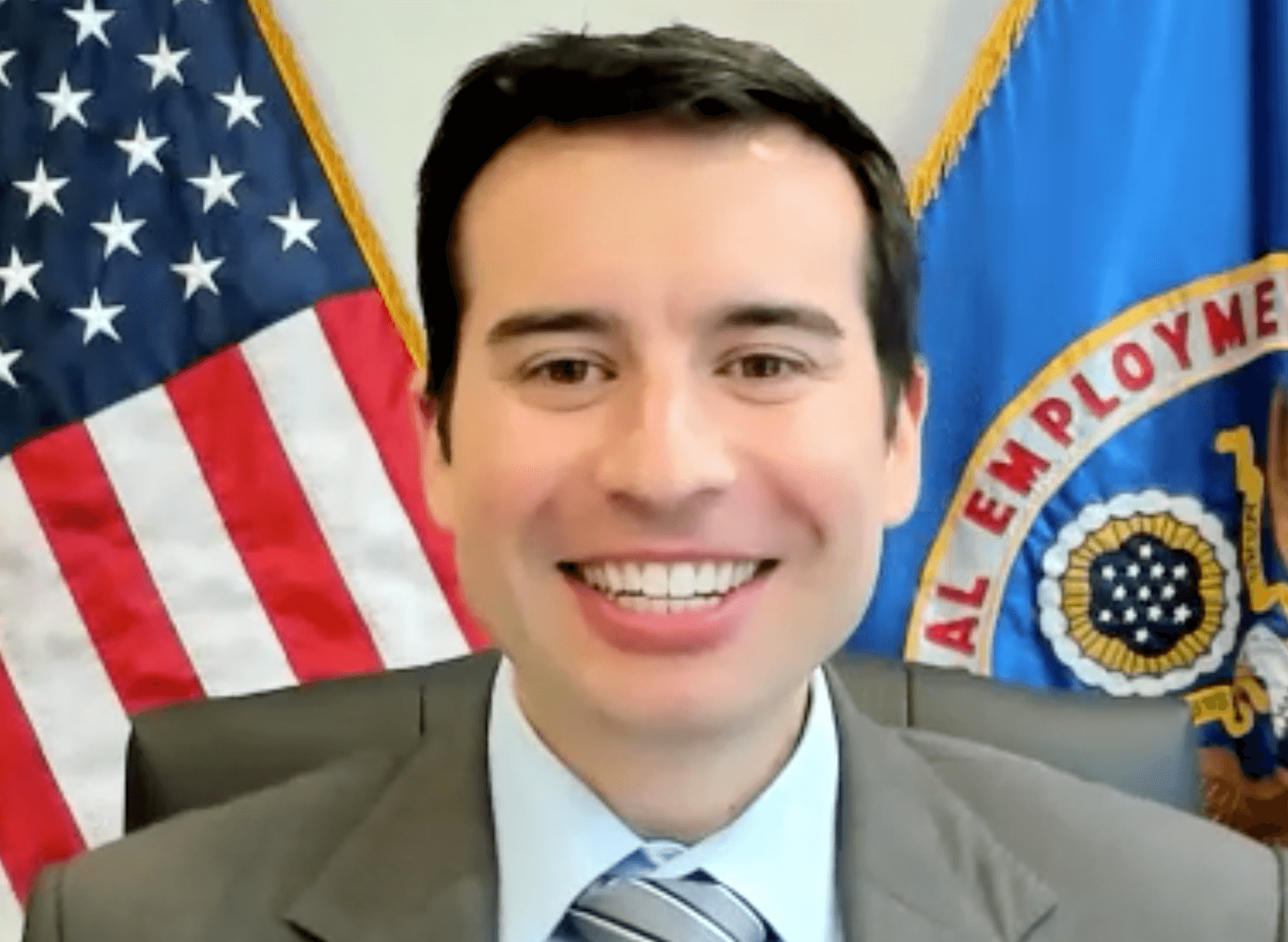
There have been three hearings on the new SEP, all are available on the EEOC’s YouTube page. There will be an opportunity to submit formal comments through the Federal Register. As the agency looks forward, we thought it was a good time to check in with Commissioner Sonderling (pictured at top next page) about priorities, trends, and more. “The most important thing for me and, I think, for all of us at the EEOC is to ensure that the Federal government is leading in creating an inclusive, barrier-free workplace because the US government is the largest employer in the country,” Sonderling said. “It’s important for Federal government to be the model employer. That falls on the EEOC to give guidance to the agencies compliance assistance to prevent discrimination and also from an enforcement perspective when discrimination occurs.

DG: Charges of discrimination are down. Why is that?

KS: I’d love to say it’s because (employees are) realizing employers are trying to do the right thing and prevent discrimination from occurring. Or that the EEOC has provided enough information to employees to know what happened may not have been discrimination. Also, too, with the economy we have now and so many jobs available, instead of going down this very long road of filing charges of discrimination, they may give up because they got another job and think, “I don’t need this anymore.”

DG: Reprisal continues to be a major problem for agencies. Based on the cases before you, what can agencies do best to limit reprisal?

KS: Well, let me tell you: It’s not just the Federal government. It’s across the board. It’s the number one filed alleged basis of discrimination in the United States. Hands down. Those are the most claims. It’s a persistent thing.

It’s not just at EEOC and in the discrimination context. The NLRB has retaliation provisions. Department of Labor, OSHA has provisions, as well.

Back in 2016, the EEOC put out broad guidance and tried to define reprisal very broadly. It’s treating employees differently because they complained about discrimination on the job, filed a complaint, participated in any manner in a charge or proceeding — theirs or someone else’s. Second, something negative has to happen

to your employment, generally, in addition to just filing charge of discrimination. What happens if you’re resisting sexual advances? Or you requested an accommodation for disability or religion? Did your work situation change in an adverse way once that occurred?

For agencies, it’s really just maintaining plain language anti-retaliation policies.

We simplified the definition in our guidance available to the public. Federal agencies’ policies and retaliation reporting procedures must do the same, just make it simple. Make it so plain language with examples of what is retaliation and what is not retaliation.

If you are fired or demoted because you are not performing well at work, you’re not hitting your goals, or just not doing the job, that’s not retaliation. But, if you are fired or demoted because you were sexually harassed or filed a charge, that’s a different story. Make it clear: This is retaliation, and this is not.

And it must come from the top. We saw this really changed with the MeToo movement. When the movement happened, it was national news. Harvey Weinstein and offending CEOs were fired. New management teams came in: What was the first message they were saying? From that CEO level, they were saying: “We’re not going to tolerate this harassment. We’re willing to fire the CEO. We’re willing to fire our rainmakers, our best performers if they are sexually harassing. And the same needs to happen here. In cabinet agencies, it needs to come from the top. It needs to come from the highest career SES, the cabinet secretaries themselves, the leaders of the agencies. This is just not going to be tolerated. We have an open-door policy. If you feel like you’re being harassed, here’s the mechanism we put in place in our agency. If you don’t feel comfortable going to that, here are alternate ways to report harassment, so you’re not dealing with the harasser or the direct manager. You can go to neutral HR or the civil rights office in your agency and not have that fear of reprisal.”

DG: Policies are important.

KS: Let’s make them easier to understand, and let’s have that commitment come from the top. So that from very first day, they know the leader of the agency is against this and it’s part of the culture at this agency.

That’s my best advice.

DG: Federal agencies often require a bar on reemployment as a term in an EEO settlement agreement for an employee who no longer works at the agency and filed an EEO complaint. Does the EEOC have a position on whether such clauses constitute retaliation per se?  

KS: Yes, the EEOC has dealt with this. And the Supreme Court has dealt with this in the private sector. They basically said: Look, it’s a contract and the parties in the settlement agreement or consent decree or however you get there, if you agree to this no re-hire policy, if it’s very clear and if it’s a legitimate nondiscriminatory reason for refusing to re-hire, then it’s valid. That is the key.

Even if settling claims of discrimination, if you’re putting in no-hire provisions, they should be explainable, and if it is later challenged, you may have to be able to provide the reasons the no-re-hire position was related to legitimate nondiscriminatory reasons. Basically, it’s a contract claim. However, Courts will not enforce contracts about future discrimination. So even in the event you have a no-rehire clause and you re-hire the individual, you cannot waive future claims of discrimination.

The EEOC dealt with this in 2003 in a Federal sector opinion [Jablonski v. NLRB, EEOC Appeal No. 01A23730]. That was a case of an employee against NLRB. We upheld that a no re-employment clause in a settlement agreement with a former employee was valid. The agency also declined to impose a reasonable limitation on the no-rehire period.

Like the Supreme Court, the EEOC finds that settlement agreements are contracts between the complaint and the agency. If the intent of the party is in the contract, that’s what’s going to control.  We rely on the plain meaning of the contract.

Where confusion arises when settling with current employees is waiving future claims of discrimination, including retaliation that has not yet occurred. Even if you had that no re-hire, and agency goes and prevents you from getting another job, that’s still retaliation.

DG: What impact did the pandemic have on employees with disabilities?

KS: Employees with existing disabilities have been largely impacted by the pandemic. For instance, they had a disability before and now the disability is more severe and now they need additional accommodations. Or, you have Federal workers who weren’t disabled and now need those accommodations because of long haul COVID.

So many Federal workers who were not disabled suddenly have become disabled post-COVID and we’re seeing that across the board, related to long haul COVID.

We’ve given out a lot of guidance on this to help Federal agencies make that determination: What is a disability now post-COVID? What is long haul COVID? Our guidance has very specific examples of the types of long haul COVID, like needing supplemental oxygen, having heart-related issues, severe fatigue, heart palpitations versus what is not COVID — a cold, congestion, sore throat.

I think the Federal agency EEO/Accommodation manager will be flooded with these requests, especially as more employees come back to the office.

[Editor’s note: Join FELTG for Reasonable Accommodation: Meeting Post-pandemic Challenges in Your Agency on Nov. 17, from 1-3 pm ET.)

DG: Technology is accelerating at such a fast pace, especially workplace technology. Is accessibility to this technology keeping up the same pace?

KS: In the private sector, companies are rapidly implementing technology like artificial intelligence to make decisions about their workforce, whether to recruit, whether to hire. The future is now.

A big concern is that workers with disabilities have the same ability to use these platforms with their disability as they would any kind of screening test. Federal agencies have had these assessment tests for decades, and a lot of them are going online. The agencies know they must accommodate both applicants and employees who are being subject to these tests.

The technology can certainly affect workers with disabilities when it comes having to do your interview online or having to take your test online.

Make sure these newer technologies don’t discriminate against any of the categories we enforce here, especially workers with disabilities. Outside of retaliation, disability discrimination is our number one cause of action in the private sector. Employers using these technologies should go through the same interactive process on the front end for applicants and during the life cycle, so employees feel comfortable asking for requests without fear they’re not going to get the job because they’re not using the program the employer spent a lot of money on buying and implementing.

With artificial technology in the ADA space, there are three takeaways:

  1. It needs to provide reasonable accommodation.
  2. The tool can’t intentionally or unintentionally screen out employees with disabilities.
  3. Make sure these tools are not seeking disability-related inquiries or not medical examinations and relevant to the job.

These are the same principles we know for reasonable accommodation, but they can’t be lost here. With HR technologies, you can’t have that set-it-and-forget-it approach.

[email protected]